Writing a cold email is only half the job.
Before a prospect reads your message, they have to notice it in a crowded inbox. Your subject line is often the first thing they see, and it can determine whether they pay attention to the email or move on.
But writing a good cold email subject line doesn't mean trying to sound clever.
In B2B outreach, the best subject lines are usually simple, relevant, specific, and natural. They give the recipient enough context to understand why the email might be worth opening without making exaggerated promises.
This matters even more when you're sending cold emails at scale. A subject line that works for one audience may perform poorly for another. A message aimed at SaaS founders, for example, may need a very different angle from one targeting IT service companies or marketing agencies.
In this guide, we'll look at how to create better cold email subject lines in 2026, what makes them work, what to avoid, and how to test them properly.
What Makes a Good Cold Email Subject Line?
A good subject line doesn't need to be complicated.
Think about the situation from the prospect's perspective.
They're probably looking at dozens of emails. They don't know you yet, and they have little reason to care about your company.
Your subject line needs to quickly answer one question:
"Why should I pay attention to this?"
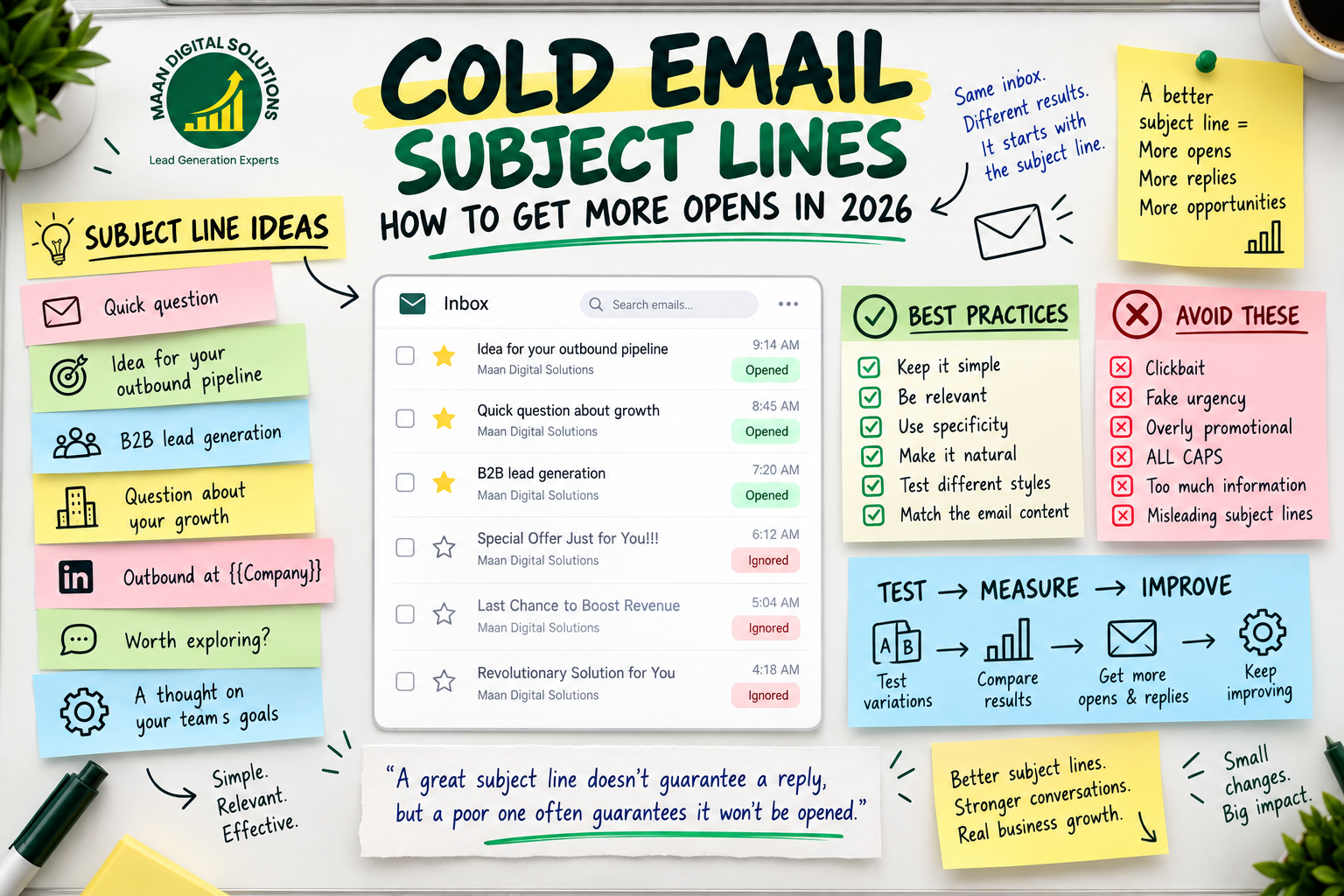
Strong subject lines generally have a few things in common:
- They are relevant to the recipient
- They are specific rather than vague
- They sound natural
- They create enough curiosity to encourage a look
- They don't make promises the email cannot support
- They match the actual content of the email
For example, compare:
"Exclusive Growth Opportunity for Your Business"
with:
"Idea for your outbound pipeline"
The second one is less dramatic, but it immediately gives the recipient some context.
That's often what you want from a B2B cold email.
1. Keep Your Subject Line Simple
One of the easiest mistakes to make is trying too hard.
Cold email subject lines don't need complicated wording, marketing language, or clever wordplay.
In many cases, a short and straightforward subject line works well because it feels more like a normal business email.
Examples:
Quick questionOutbound pipelineYour LinkedIn strategyLead generationIdea for {{company}}Regarding your sales teamA question about growth
The goal isn't to make every subject line exciting.
The goal is to make it relevant enough to earn attention.
2. Make the Subject Line Relevant to the Prospect
Relevance is more important than cleverness.
If your prospect is a SaaS founder, the subject line should make sense for someone running a SaaS company.
If you're contacting an IT agency, the subject line can relate to their client acquisition, sales pipeline, or outbound strategy.
For example:
For a SaaS company:
Outbound for {{company}}
For an IT agency:
New client acquisition
For a marketing agency:
Agency pipeline idea
The subject line doesn't have to explain everything.
It simply needs to establish enough relevance that the recipient thinks:
"This might actually be about my business."
3. Use Specificity Instead of Generic Claims
Generic subject lines are easy to ignore.
Consider:
Grow Your Business Faster
There's nothing particularly specific about it.
Almost every business receives emails making some version of that promise.
Instead, you could make the subject more specific:
Your outbound pipeline
or:
LinkedIn lead generation
or:
US SaaS prospecting
The more closely the subject matches the actual problem or opportunity you're discussing, the more meaningful it becomes.
Specificity also makes personalization easier.
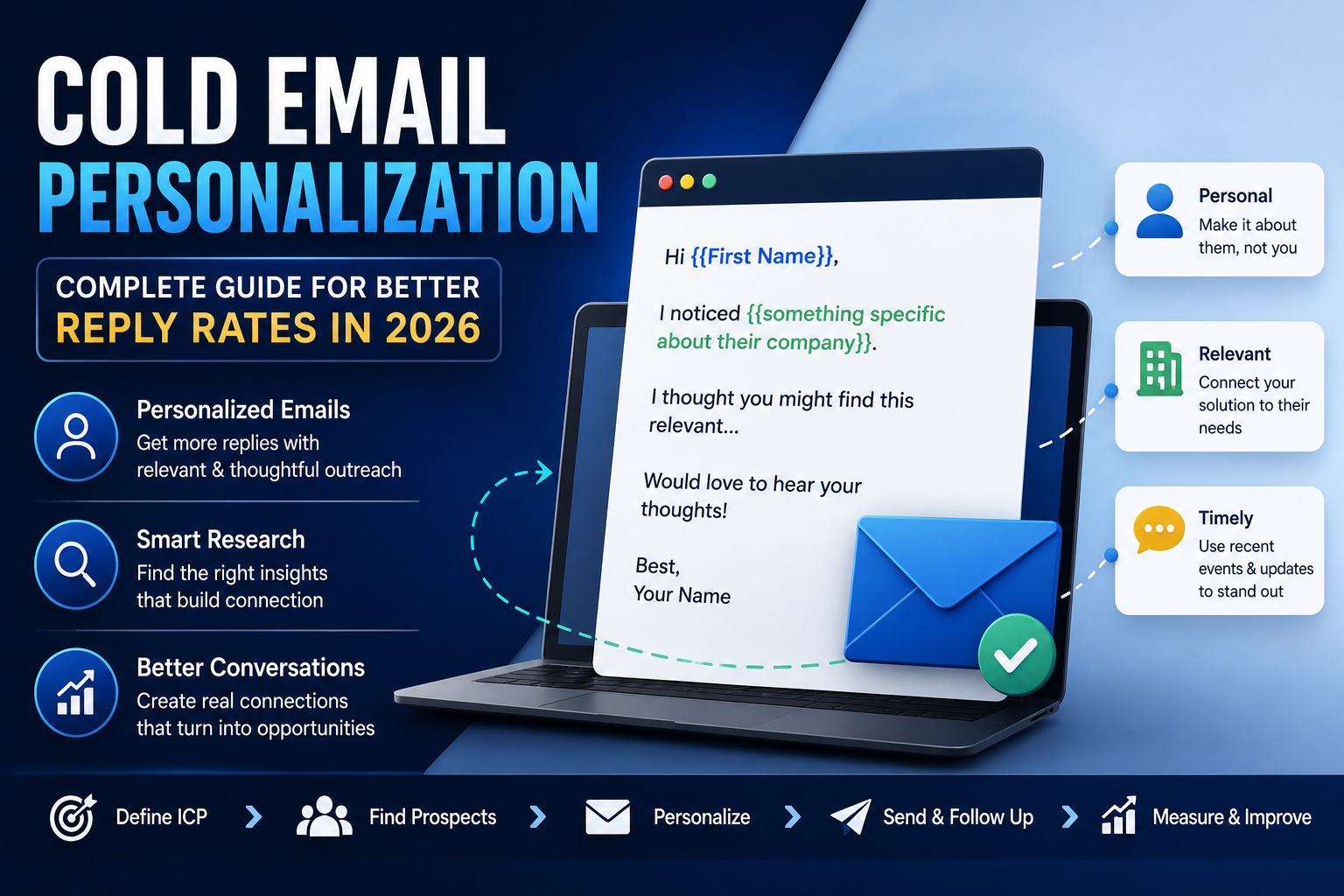
4. Personalization Doesn't Always Mean Using Their First Name
Personalization is frequently misunderstood.
Adding:
John, quick question
doesn't automatically make an email personalized.
The recipient's first name is just a data field.
More useful personalization comes from understanding something about the company, role, market, or situation you're contacting them about.
For example:
Scaling outbound at {{company}}
is more contextually relevant than:
John, let's grow {{company}}
You can personalize around:
- Company
- Industry
- Job role
- Product
- Market
- Geography
- Recent business activity
- Hiring
- Growth stage
- Sales model
- Customer type
The subject line should feel connected to the reason you're reaching out.
That is much more useful than inserting a name simply because your email platform allows it.
5. Don't Try to Say Everything in the Subject Line
Your subject line isn't your sales pitch.
This is a common mistake.
For example:
"We help B2B SaaS companies generate 50+ qualified leads every month using LinkedIn and cold email"
That's too much information for a subject line.
It feels promotional and leaves nothing for the email itself to explain.
A simpler version could be:
B2B SaaS outbound
Then the body can explain what you're referring to.
Think of the subject line as an entry point, not the entire message.
6. Use Curiosity Without Becoming Clickbait
Curiosity can help, but there is an important difference between curiosity and clickbait.
A subject like:
You won't believe this
may create curiosity, but it doesn't provide useful context.
A subject like:
One idea for your outbound
creates curiosity while still telling the recipient what the email is about.
Good curiosity gives the recipient a reason to look.
Bad curiosity tries to trick them into opening.
For B2B outreach, the first approach is usually more appropriate because trust matters.
7. Avoid Fake Urgency
Cold emails don't usually need artificial urgency.
Subject lines such as:
UrgentFinal opportunityLast chanceAct nowImportant!!!
can feel promotional when there is no genuine reason for urgency.
If there really is a deadline, event, or time-sensitive situation, mention it honestly.
Otherwise, there is little benefit in creating artificial pressure.
8. Avoid Spammy or Overly Promotional Language
Your subject line should sound like something a real person might actually send.
Be cautious with excessive:
- ALL CAPS
- Multiple exclamation marks
- Overly promotional claims
- Unnecessary emojis
- Aggressive sales language
- Fake questions
- Sensational claims
For example:
"🔥🔥 MASSIVE GROWTH OPPORTUNITY FOR YOUR BUSINESS!!!"
doesn't feel like a normal B2B conversation.
Something like:
"Idea for your outbound pipeline"
is much more natural.
Also remember that subject lines are only one part of deliverability. Gmail's current sender guidance emphasizes authentication, spam rates, and sender reputation, rather than treating a particular subject-line trick as a way around filtering.
9. Try Different Subject Line Styles
There isn't one subject-line formula that works for every campaign.
Instead, test different approaches.
Question-Based
Examples:
Looking at outbound?How are you handling lead generation?Worth exploring?
These can work when the question is genuinely relevant to the recipient.
Problem-Based
Examples:
Outbound pipelineLead generation challengeFinding more qualified leads
This approach focuses on a problem the prospect may recognize.
Benefit-Based
Examples:
More qualified conversationsImproving outbound resultsBuilding a predictable pipeline
The benefit should be realistic and connected to the email.
Company-Specific
Examples:
Idea for {{company}}Outbound at {{company}}A thought on {{company}}
This works particularly well when the email itself contains genuine company-specific research.
Topic-Based
Examples:
B2B lead generationCold email strategyLinkedIn outreachOutbound sales
These are simple and direct.
They can work particularly well when the topic itself is highly relevant.
10. Don't Make Every Subject Line Look Like Marketing
One useful test is to imagine that the email came from a colleague.
Would the subject line look normal in an internal inbox?
For example:
"Quick question"
looks like a normal email.
"Unlock 10X Revenue With Our Revolutionary Solution"
looks like marketing.
That's not automatically bad for every type of email, but cold B2B outreach often benefits from sounding like a genuine business conversation rather than an advertisement.
Your goal is not to disguise a sales email.
Your goal is to make the communication clear, relevant, and respectful.
11. Match the Subject Line to the Email
This sounds obvious, but it is frequently overlooked.
If the subject says:
"LinkedIn lead generation"
and the email immediately starts talking about website redesign, there is a disconnect.
The prospect opened the email expecting one topic and received another.
That can hurt trust.
A good subject line should accurately represent the conversation that follows.
Think of it as a promise:
Subject → Email → CTA
All three should tell the same story.
12. Test Subject Lines by Segment
Don't assume one subject line will work equally well for every prospect.
Consider separating your audience into segments.
For example:
SaaS Founders
Test subjects around:
- outbound growth
- sales pipeline
- new customer acquisition
- founder-led sales
IT Agencies
Test subjects around:
- new projects
- client acquisition
- outbound sales
- agency pipeline
Marketing Agencies
Test subjects around:
- agency growth
- client acquisition
- predictable pipeline
- outbound prospecting
The underlying service may be the same.
The context is different.
That's why segmentation matters.
13. Don't Obsess Over Open Rates
Open rate has traditionally been one of the most common email metrics.
But in 2026, it should be treated carefully.
Apple's Mail Privacy Protection can prevent senders from knowing whether a recipient actually opened an email, while Gmail explicitly states that Google does not track open rates and cannot verify the accuracy of open-rate figures reported by third parties.
That doesn't mean subject lines are irrelevant.
It means you shouldn't judge a campaign only by reported opens.
Instead, pay attention to metrics closer to the actual business outcome:
- Reply rate
- Positive reply rate
- Qualified conversations
- Meetings booked
- Meeting show rate
- Opportunities created
- Pipeline generated
For example, a campaign with a lower reported open rate but significantly more qualified replies may be more useful than one with impressive open numbers and almost no conversations.
14. A/B Test Your Subject Lines Properly
If you want to know which subject line performs better, don't change five things at once.
Test one variable.
For example:
Version A:Outbound pipeline
Version B:B2B outbound
Keep the rest of the campaign relatively consistent.
You can then test another variable:
Version A:Quick question
Version B:Question about outbound
Over time, this gives you a clearer understanding of what your audience responds to.
What Should You Test?
You can test:
Length
Short vs. slightly longer.
Question vs. Statement
Looking at outbound?
vs.
Outbound pipeline
Personalized vs. General
Idea for {{company}}
vs.
Outbound pipeline
Problem vs. Outcome
Lead generation challenge
vs.
More qualified conversations
Specific vs. Broad
LinkedIn lead generation
vs.
Lead generation
The key is to avoid changing everything simultaneously.
15. Don't Declare a Winner Too Quickly
Small differences can be misleading.
If one subject line receives slightly more replies than another, that doesn't necessarily mean you've discovered a universal winning formula.
The audience, sample size, industry, offer, timing, sender reputation, and email content can all influence results.
Instead, look for patterns across multiple campaigns.
For example:
If highly specific subject lines consistently generate better-quality conversations among your SaaS segment, that's more useful than a single campaign producing a small difference.
Use testing to build your own campaign knowledge, rather than chasing generic "best subject line" lists.
16. Use the Subject Line With the Preview Text
The subject line isn't always working alone.
Depending on the email client, the recipient may also see part of the first sentence as preview text.
That means the first line of your email can work together with the subject.
For example:
Subject:Outbound pipeline
Opening:I noticed you're expanding your sales team in the US...
Together, they provide more context than the subject line alone.
This is especially useful when the subject is intentionally short.
Instead of forcing the entire message into the subject line, you can use the combination of:
Subject + Preview + First sentence
to create a natural introduction.
17. Subject Line Formulas You Can Test
Here are several simple formulas you can adapt.
Formula 1: Topic
[Topic]
Example:
Outbound lead generation
Formula 2: Topic + Company
[Topic] for [Company]
Example:
Outbound for Acme
Formula 3: Question
Quick question about [topic]
Example:
Quick question about outbound
Formula 4: Idea
Idea for [company/topic]
Example:
Idea for your sales pipeline
Formula 5: Problem
[Problem]
Example:
Building a predictable pipeline
Formula 6: Observation
[Observation]
Example:
Saw you're hiring sales reps
This works best when the observation is genuine and relevant.
Formula 7: Specific Opportunity
[Opportunity]
Example:
US SaaS prospecting
The more specific the context, the more useful this becomes.
18. Subject Lines to Avoid
Here are some common patterns that can make cold emails feel less credible.
Overpromising
Double Your Revenue in 30 Days
Fake Personalization
John, I have an amazing opportunity for you
when the rest of the email is completely generic.
Excessive Urgency
FINAL CHANCE!!!
Too Much Hype
The #1 Revolutionary Lead Generation Solution
Too Much Information
We Help IT Companies Generate More Leads Through LinkedIn, Email and Upwork
Clickbait
You won't believe what I discovered
Vague Sales Language
Business Opportunity
The problem isn't necessarily one particular word.
It's the overall impression.
If the subject feels exaggerated, generic, or disconnected from the actual email, it becomes easier to ignore.
19. A Practical Cold Email Subject Line Checklist
Before launching your campaign, run every subject line through this checklist.
Relevance
Does this make sense for the person receiving it?
Clarity
Can they understand the general topic immediately?
Specificity
Does it provide enough context to feel meaningful?
Natural Language
Would a real person actually write this?
Accuracy
Does it match the email content?
Personalization
Is the personalization meaningful rather than just a first-name token?
No Hype
Are you avoiding exaggerated claims?
No Fake Urgency
Is there a legitimate reason for urgency if you're using one?
Testing
Have you tested more than one approach?
Business Outcome
Are you measuring replies and qualified conversations, not just opens?
If the answer is yes to most of these, your subject line is probably doing its job.
20. The Best Cold Email Subject Line Is Often the Simplest One
There is a temptation to keep searching for the perfect subject line.
In reality, there probably isn't one.
A subject line that performs well for a SaaS founder may not work for an IT agency. A subject line that gets replies from one market may perform differently in another.
That's why the better approach is to build a repeatable testing process.
Start with subject lines that are:
- Relevant
- Specific
- Short enough to scan
- Natural
- Honest
- Connected to the email
Then test them against actual campaign outcomes.
And remember that the subject line is only the first step.
A great subject line cannot fix a poor prospect list, irrelevant offer, weak personalization, bad deliverability, or an email that doesn't give the prospect a reason to respond.
The strongest cold email campaigns treat the entire process as a system:
Right Prospect → Relevant Subject → Useful Message → Clear Next Step → Follow-Up → Measurable Outcome
That's where subject lines become valuable—not as a trick to get more opens, but as the first step in starting a relevant B2B conversation.