

Introduction
Finding the right company is only the first step in B2B prospecting.
You can have a highly targeted list of companies, but if you're contacting the wrong person, your outreach may never turn into a meaningful conversation.
This is one of the most common problems in B2B sales.
A company may be a perfect fit for your product or service, but the person you contacted may not be involved in the buying decision. They may forward your message internally, ignore it, or simply have no reason to respond.
That's why identifying the right decision-maker is such an important part of outbound sales.
In 2026, B2B teams have access to more prospecting data than ever. But having access to information doesn't automatically mean you know who to contact, why they matter, or how to approach them.
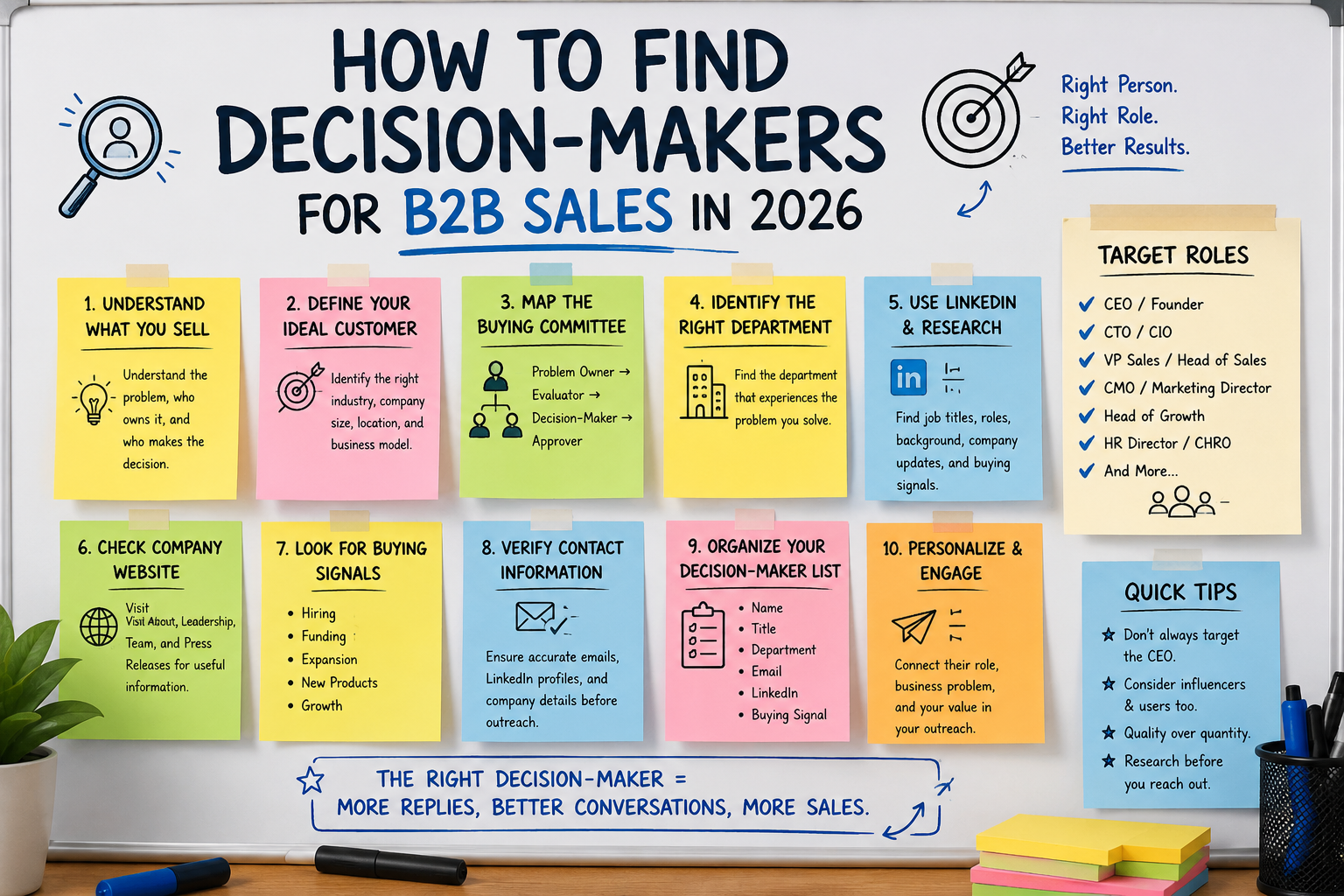
In this guide, you'll learn how to find B2B decision-makers, identify the right roles, research prospects, qualify contacts, and build a decision-maker list that supports better outbound campaigns.
What Is a B2B Decision-Maker?
A B2B decision-maker is a person who has significant influence over whether a company purchases a product or service.
The decision-maker isn't always the CEO.
Depending on the product, company structure, and purchase, the buying process may involve several people.
For example, a software purchase could involve:
- Head of Technology
- CTO
- IT Manager
- Finance Manager
- Procurement
- CEO
One person may identify the problem, another may evaluate solutions, and another may approve the budget.
That's why modern B2B prospecting should consider the buying group, not just one contact.
Why Finding the Right Decision-Maker Matters
Your outreach performance depends heavily on who receives your message.
Contacting the right person can improve:
- Relevance
- Response rates
- Conversation quality
- Meeting opportunities
- Sales efficiency
On the other hand, contacting the wrong person can waste time and outreach capacity.
A useful rule is:
The closer your prospect is to the problem you're solving, the more relevant your outreach is likely to be.
Decision-Maker vs Influencer vs End User
Not everyone involved in a B2B purchase has the same role.
Understanding the difference can improve your prospecting strategy.
Decision-Maker
This person has authority to approve or influence the purchase.
Examples:
- CEO
- Founder
- CMO
- CTO
- VP Sales
Influencer
An influencer may recommend a solution even if they don't have final approval.
Examples:
- Sales Manager
- Marketing Manager
- IT Manager
- Operations Manager
End User
The end user works directly with the product or service.
Their feedback can strongly influence the purchase decision.
For example, a sales representative may use a sales platform while the VP of Sales approves the purchase.
Step 1: Understand What You Are Selling
Before searching for decision-makers, clearly understand the problem your product or service solves.
Ask:
- What business problem does the solution address?
- Which department experiences that problem?
- Who is responsible for solving it?
- Who controls the budget?
- Who is likely to evaluate the solution?
This helps you identify the right roles instead of automatically targeting senior executives.
Step 2: Define Your Ideal Customer Profile
Your Ideal Customer Profile should describe the companies you want to target.
Consider:
- Industry
- Company size
- Revenue
- Geography
- Business model
- Technology environment
- Growth stage
For example, an agency targeting B2B SaaS companies might define its ICP as:
Industry: B2B SaaS
Company size: 50–500 employees
Market: United States
Business model: Subscription SaaS
Potential need: Consistent sales pipeline
Once the company profile is clear, identifying the right decision-maker becomes much easier.
Step 3: Map the Buying Committee
For larger B2B purchases, don't assume there is only one decision-maker.
Instead, map the potential buying committee.
A simple framework is:
Problem Owner → Evaluator → Decision-Maker → Approver
For example:
A company needs more qualified sales opportunities.
- Sales Manager → identifies the problem
- Head of Sales → evaluates solutions
- VP Sales → makes the decision
- CEO/CFO → approves the budget
Your outreach strategy can account for this structure.
Step 4: Identify the Department Responsible for the Problem
The problem you're solving usually points toward the right department.
Lead Generation Services
Potential contacts:
- Founder
- CEO
- Head of Sales
- VP Sales
- Head of Growth
Marketing Services
Potential contacts:
- CMO
- Marketing Director
- Head of Marketing
- VP Marketing
Software Development
Potential contacts:
- CTO
- CIO
- VP Engineering
- Head of Technology
- Founder
Recruitment Services
Potential contacts:
- HR Director
- Head of Talent
- Talent Acquisition Manager
- CHRO
The correct role depends on the specific business problem.
Step 5: Use LinkedIn to Research Decision-Makers
LinkedIn is one of the most useful platforms for B2B prospect research.
You can use it to identify:
- Job titles
- Company roles
- Seniority
- Professional background
- Company changes
- Recent activity
Don't use LinkedIn only to find an email address.
Use it to understand who the person is and what they are responsible for.
For a broader LinkedIn strategy, see our LinkedIn Lead Generation Strategy: Get B2B Clients in 2026.
Step 6: Search Company Websites
A company's website can provide useful information about its leadership and organizational structure.
Look at pages such as:
- About
- Leadership
- Team
- Management
- Contact
- Press releases
Company websites can also reveal important context about:
- New products
- Expansion
- Hiring
- Target markets
- Business priorities
This information can help you determine which department or executive is most relevant.
Step 7: Use Job Titles Strategically
Job titles vary significantly between companies.
One company might use:
VP Sales
while another uses:
Chief Revenue Officer
and another uses:
Head of Revenue
All three may be relevant to a sales-related solution.
Therefore, don't search for only one exact job title.
Build a list of relevant title variations.
For example:
Sales
- Chief Revenue Officer
- VP Sales
- Sales Director
- Head of Sales
- Sales Manager
- Revenue Director
Marketing
- Chief Marketing Officer
- VP Marketing
- Marketing Director
- Head of Marketing
- Head of Growth
- Growth Director
This increases your chances of finding the right contact.
Step 8: Look for Buying Signals
Finding the right job title is useful.
Finding the right job title at the right time is even better.
Look for signals such as:
- New leadership
- Recent funding
- Expansion
- New market entry
- Hiring activity
- Product launches
- Technology changes
- Rapid employee growth
For example, if a company has recently expanded its sales team, it may have new requirements around lead generation, sales technology, or appointment setting.
These signals can help you prioritize prospects.
Step 9: Verify Contact Information
Once you've identified the right person, make sure the contact information is accurate.
Important information includes:
- Full name
- Job title
- Company
- Business email
- LinkedIn profile
- Company website
Email verification is particularly important when you're planning cold email outreach.
Sending campaigns to invalid addresses can increase bounce rates and negatively affect your sender reputation.
Our Email Verifier can be used to check prospect email addresses before launching outreach campaigns.
Step 10: Organize Your Decision-Maker Database
Don't keep prospect information scattered across spreadsheets, notes, and different tools.
Create a structured database.
Useful fields include:
| Field | Purpose |
|---|---|
| Company | Identify the target account |
| Contact Name | Identify the prospect |
| Job Title | Understand their role |
| Department | Connect the person to the business problem |
| Outreach | |
| Research and engagement | |
| Industry | Segmentation |
| Company Size | ICP qualification |
| Location | Geographic targeting |
| Buying Signal | Prioritization |
| Prospect Status | Track outreach |
A structured database makes your prospecting process easier to manage and scale.
How to Find Decision-Makers for Different B2B Services
The right decision-maker depends heavily on the offer.
For Lead Generation Services
Target:
- Founder
- CEO
- VP Sales
- Head of Sales
- Head of Growth
Focus on companies that need a more consistent sales pipeline.
For Digital Marketing Services
Target:
- CMO
- Marketing Director
- Head of Marketing
- VP Marketing
- Founder
Focus on companies actively investing in customer acquisition and growth.
For IT Services
Target:
- CTO
- CIO
- VP Engineering
- IT Director
- Head of Technology
- Founder
Focus on companies experiencing technology, development, or infrastructure needs.
For Recruitment Services
Target:
- CHRO
- HR Director
- Head of Talent
- Talent Acquisition Director
Look for businesses that are actively hiring or expanding.
A Simple Decision-Maker Qualification Framework
Before adding a contact to your outreach campaign, ask five questions.
1. Does the company match our ICP?
If not, remove the account.
2. Is this person connected to the problem?
If not, find another contact.
3. Does this person have influence?
Look for the appropriate level of seniority and responsibility.
4. Is there a relevant business signal?
A current need makes outreach more timely.
5. Is the contact information accurate?
Verify the data before sending.
This simple process can dramatically improve the quality of your prospect database.
Common Mistakes When Finding B2B Decision-Makers
Always Targeting the CEO
The CEO isn't automatically the right person.
In larger organizations, the relevant department head may be much more appropriate.
Searching for Only One Job Title
Companies use different titles for similar responsibilities.
Always consider title variations.
Ignoring Company Structure
A decision-maker at a 20-person company may have a completely different role from one at a 2,000-person company.
Contacting Multiple People Without a Strategy
Reaching out to several employees at the same company can work, but it should be coordinated.
Avoid sending identical messages to everyone.
Skipping Research
Knowing someone's job title isn't enough.
Understanding what they are responsible for makes your outreach more relevant.
Ignoring Data Quality
Incorrect email addresses and outdated job information can waste your outreach efforts.
Keep your database clean and updated.
How to Build a Decision-Maker Prospecting Workflow
A repeatable workflow can look like this:
Define ICP
↓
Find Target Companies
↓
Identify Relevant Department
↓
Find Decision-Makers
↓
Research Buying Signals
↓
Verify Contact Information
↓
Segment Prospects
↓
Start Outreach
↓
Follow Up
↓
Book Sales Meetings
This connects decision-maker research directly with your broader outbound sales process.
Decision-Maker Research Checklist
Before adding a contact to your campaign, check:
-
Company matches your ICP
-
Person works at the company
-
Job title is relevant
-
Department matches your solution
-
Seniority is appropriate
-
Business email is available
-
Email has been verified
-
LinkedIn profile has been reviewed
-
Relevant business signal identified
-
Prospect has been assigned to the correct campaign
The more consistently you follow this process, the stronger your outbound database becomes.
What to Do After Finding the Decision-Maker
Finding the right person is only the beginning.
The next step is creating relevant outreach.
Your messaging should connect three things:
Their Role + Their Potential Problem + Your Value
For example:
Instead of explaining everything your company does, focus on a problem that is relevant to their responsibilities.
This makes the conversation more useful and less like a generic sales pitch.
For more information, see our Cold Email Personalization: Complete Guide for Better Reply Rates in 2026.
You can also learn how to build the complete prospecting process in our How to Build a B2B Prospect List That Converts in 2026 guide.
Build a Better B2B Prospecting System
Finding decision-makers is easier when your prospecting process is structured from the beginning.
Define your ICP, identify the right companies, find relevant decision-makers, verify contact information, and segment your prospects before starting outreach.
Conclusion
Finding B2B decision-makers isn't simply about searching for people with senior job titles.
It's about understanding who owns the problem you're solving, who influences the buying decision, and when that person is most likely to be interested in a conversation.
Start with a clear Ideal Customer Profile.
Identify the right companies.
Find the department connected to your solution.
Research relevant job titles and decision-makers.
Look for buying signals.
Verify contact information.
Then build personalized outreach around the prospect's role and business needs.
When you combine accurate prospect data with relevant messaging, your outbound campaigns become more focused and more efficient.
The objective isn't to contact every executive you can find.
It's to find the right person at the right company at the right time.
That's what turns B2B prospecting into a real sales pipeline.
