Introduction
A good cold email campaign starts with good data.
You can spend hours defining your ideal customer profile, finding decision-makers, writing personalized messages, and building follow-up sequences. But if your prospect list contains invalid or outdated email addresses, your campaign can run into problems before your message has a chance to generate a conversation.
This is why email verification has become an important part of modern cold email outreach.
Email verification helps determine whether an email address is likely to be deliverable before you send your campaign. It can help reduce unnecessary bounces, improve list quality, and give your outreach system a cleaner foundation.
In 2026, email authentication and sender reputation are also increasingly important. Gmail and Yahoo both maintain sender requirements around authentication, spam rates, and sending practices, making data quality just one part of a broader deliverability strategy.
In this guide, we'll explain what email verification is, why it matters for cold email, how it works, when you should verify a list, and how to build email verification into your outbound workflow.
What Is Email Verification?
Email verification is the process of checking whether an email address is valid and likely to accept email before you send a message to it.
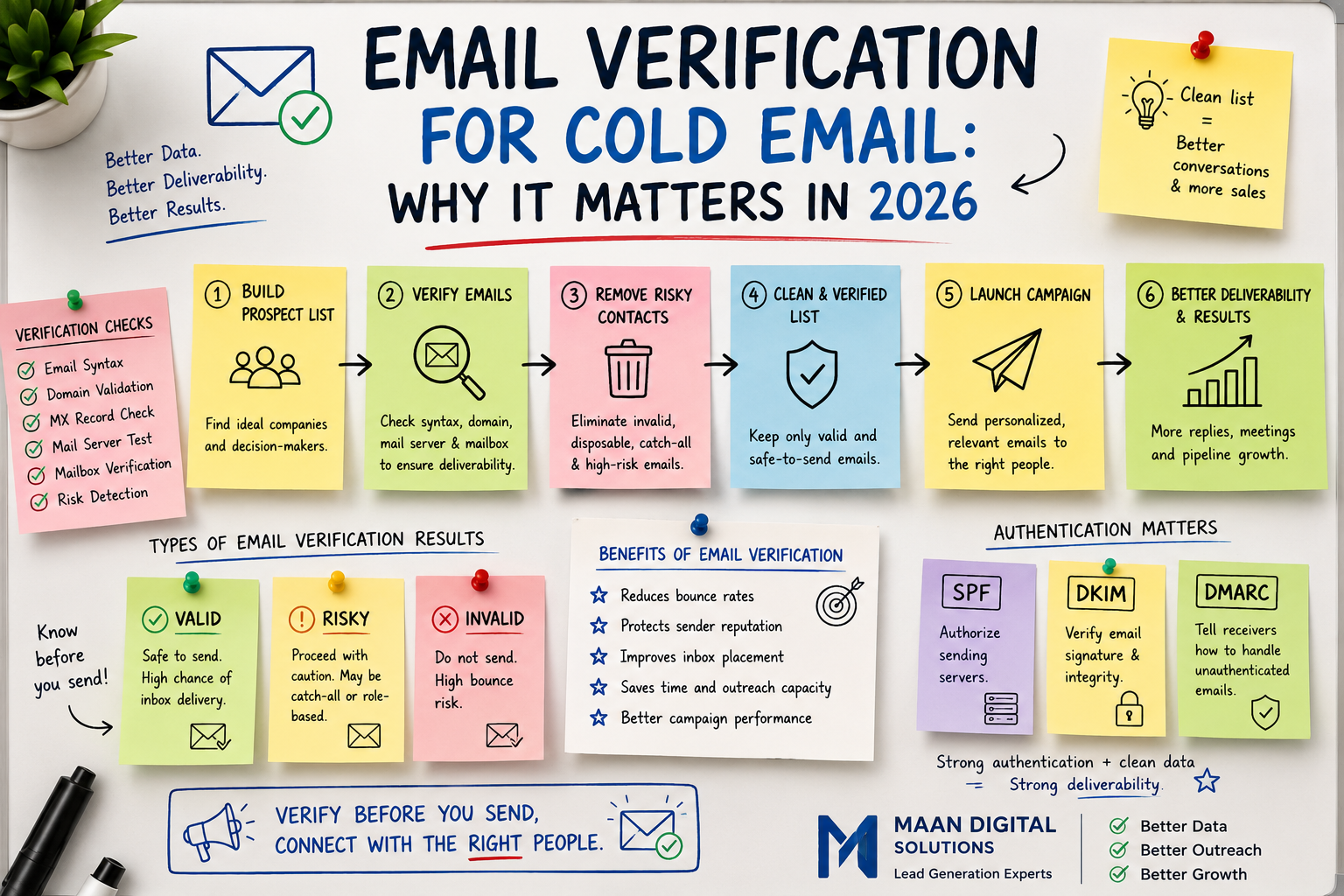
A verification system can examine different characteristics of an email address, including:
- Whether the email format is valid
- Whether the domain exists
- Whether the domain has mail servers configured
- Whether the mailbox appears to be reachable
- Whether the address presents potential delivery risks
The goal is simple:
Identify problematic addresses before they become bounced emails.
Email verification doesn't guarantee that an email will reach the inbox. Deliverability also depends on factors such as sender reputation, authentication, message content, recipient engagement, and sending behavior.
But starting with clean data gives your campaign a much stronger foundation.
Why Email Verification Matters for Cold Email
Cold email depends heavily on the quality of your prospect database.
If your list contains outdated or invalid addresses, you may end up sending messages that can never reach the intended recipient.
That creates several problems.
Higher Bounce Rates
A bounce occurs when an email cannot be delivered to the intended recipient.
Sending to large numbers of invalid addresses can increase your bounce rate and indicate that your contact data needs attention.
Wasted Outreach
Every email sent to an invalid address is an opportunity wasted.
Your team could instead spend that outreach capacity contacting prospects with valid business addresses.
Deliverability Risk
Email providers evaluate many signals when determining how to handle incoming mail.
Sender reputation, recipient feedback, authentication, and sending behavior all matter.
Clean contact data helps reduce one avoidable source of delivery problems.
Poor Campaign Performance
If a significant portion of your prospect list is invalid, your campaign metrics become less useful.
For example, suppose you have:
1,000 prospects
but 150 addresses are invalid.
You're not really running a 1,000-prospect campaign.
You're potentially working with only 850 usable contacts.
Email Verification vs Email Validation
These terms are sometimes used interchangeably, but there is a useful distinction.
Email Validation
Validation generally checks whether an email address follows the expected format and structure.
For example:
name@company.com
is structurally different from:
name@company
Email Verification
Verification goes further by checking additional information about the domain and mailbox to determine whether the address is likely to accept email.
For cold email campaigns, deeper verification is generally more useful than checking formatting alone.
What Does an Email Verification System Check?
Different verification providers use different methods, but a typical verification process can examine several signals.
1. Syntax
The system checks whether the email address follows a valid format.
2. Domain
The system checks whether the domain exists and appears to be configured for email.
For example:
company.com
may exist as a website but not necessarily have a working mail configuration.
3. Mail Server
The domain's mail exchange configuration can provide additional information about whether it is set up to receive email.
4. Mailbox Signals
Some verification systems perform additional checks to determine whether a mailbox appears reachable.
However, mailbox verification is not always definitive.
Some mail servers intentionally restrict verification attempts or accept messages for multiple addresses.
That's why verification results should be treated as indicators of delivery risk rather than absolute guarantees.
5. Risk Indicators
Verification systems may also identify addresses that require additional caution.
Examples can include:
- Disposable email addresses
- Role-based addresses
- Catch-all domains
- Known risky addresses
- Invalid domains
The exact categories depend on the verification provider.
What Is a Catch-All Email?
A catch-all domain is configured to accept email for many or potentially all addresses at that domain, even when the specific mailbox doesn't exist.
For example, you might have:
hello@company.com
and
randomname@company.com
The domain could accept both without confirming whether the second mailbox is actually used.
This makes catch-all addresses more difficult to verify with certainty.
Instead of treating them as guaranteed deliverable, it's better to consider them a separate risk category.
What Are Disposable Email Addresses?
Disposable email addresses are temporary addresses created for short-term use.
They are commonly associated with:
- temporary signups
- testing
- short-lived accounts
- free trials
They are generally not appropriate for B2B prospecting because they are unlikely to represent a long-term business contact.
Removing these addresses can help keep your prospect database focused on genuine business contacts.
When Should You Verify Your Email List?
Email verification shouldn't happen only once.
It can be useful at multiple stages of your prospecting process.
Before Launching a Campaign
This is the most obvious stage.
Before uploading a prospect list into your cold email platform, verify the addresses and remove or separate risky contacts.
After Building a New Prospect List
If you've collected hundreds or thousands of new contacts, verify the data before using it.
This is especially important when information comes from multiple sources.
Before Reusing an Old List
An email address that was valid several months ago may not remain valid forever.
People change jobs.
Companies close.
Domains change.
Email addresses get deactivated.
If you're reusing an old database, verify it again.
During Ongoing List Maintenance
For companies running outbound campaigns continuously, list hygiene should be an ongoing process rather than a one-time task.
Regularly remove:
- Invalid addresses
- Outdated contacts
- Unwanted records
- Duplicate contacts
How Email Verification Fits Into a Cold Email Workflow
A strong cold email process can look like this:
Define ICP
↓
Find Target Companies
↓
Identify Decision-Makers
↓
Build Prospect List
↓
Verify Email Addresses
↓
Segment Prospects
↓
Personalize Outreach
↓
Send Campaign
↓
Follow Up
↓
Measure Results
Email verification sits between prospecting and outreach.
That makes sense because you want to clean your data before putting it into your sending system.
Email Verification and Email Deliverability
Email verification is important, but it is not the same thing as deliverability.
This distinction is important.
Email Verification
Answers:
"Is this email address likely to be deliverable?"
Email Deliverability
Answers:
"How likely is my email to reach the recipient's inbox?"
Deliverability depends on much more than the recipient's email address.
For example:
- SPF
- DKIM
- DMARC
- Sender reputation
- Spam complaints
- Sending volume
- Email content
- Recipient engagement
- Infrastructure configuration
Gmail currently requires all senders to use at least SPF or DKIM, while bulk senders to personal Gmail accounts must use SPF, DKIM, and DMARC. Gmail also recommends keeping spam rates below 0.1% and preventing them from reaching 0.3% or higher.
Yahoo similarly requires authentication for senders and has additional requirements for bulk senders, including SPF, DKIM, DMARC, easy unsubscribe for applicable messages, and low spam complaint rates.
So verification should be viewed as one part of a larger deliverability strategy.
Why SPF, DKIM, and DMARC Still Matter
Email verification cleans the recipient side of your campaign.
Email authentication helps establish trust on the sending side.
SPF
SPF identifies which servers or services are authorized to send email on behalf of a domain.
DKIM
DKIM adds a cryptographic signature that allows receiving systems to verify that a message was authorized by the signing domain and wasn't altered in transit.
DMARC
DMARC builds on SPF and DKIM by allowing domain owners to define how receiving systems should handle messages that fail authentication checks.
It also provides reporting capabilities that can help organizations understand authentication activity.
Google recommends setting up SPF, DKIM, and DMARC for sending domains, while its current requirements distinguish between requirements for all senders and additional requirements for bulk senders.
How to Choose an Email Verification Tool
Not every verification tool provides the same level of information.
When evaluating a solution, consider:
Accuracy
How effectively does it identify invalid or risky addresses?
Risk Categories
Does it distinguish between invalid, catch-all, disposable, and other types of addresses?
Bulk Verification
Can you verify large lists efficiently?
API Access
If you're building automated workflows, an API can be useful.
Export Options
Can you easily download or integrate verification results?
Credit Usage
Understand how the provider counts verification credits.
Data Security
Consider how the provider handles uploaded contact data and whether its policies are appropriate for your business.
How to Reduce Bounce Rates Before Sending Cold Email
Email verification is only one step.
Use a complete data-quality process.
1. Start With a Relevant Prospect List
Don't collect contacts simply because you can.
Target businesses that match your ICP.
2. Identify the Correct Decision-Maker
Make sure the person is relevant to the problem you're solving.
3. Verify Their Email
Check the address before sending.
4. Remove or Separate Risky Addresses
Don't treat every verification result the same.
5. Keep Your Database Updated
Review older records before reusing them.
6. Monitor Campaign Results
Watch bounce rates and other campaign signals.
If bounce rates increase, stop and investigate instead of simply increasing sending volume.
Common Email Verification Mistakes
Verifying Only After a Campaign Fails
By then, you've already sent emails to potentially problematic addresses.
Verify before sending.
Assuming "Valid" Means "Inbox Guaranteed"
No verification system can guarantee inbox placement.
A valid address can still:
- reject messages
- have a full mailbox
- route messages to spam
- have restrictive security policies
Verification is a risk assessment, not an inbox-placement guarantee.
Ignoring Catch-All Addresses
Catch-all domains can be difficult to verify with certainty.
Treat them according to your risk tolerance and campaign strategy.
Never Cleaning Old Lists
Email databases become outdated.
Regular list maintenance matters.
Focusing Only on Email Verification
Verification won't solve problems caused by poor sender reputation, missing authentication, excessive volume, or irrelevant messaging.
Think of deliverability as a system.
Email Verification Checklist for Cold Email
Before launching a campaign, check:
-
Prospect list matches your ICP
-
Decision-makers have been identified
-
Duplicate contacts have been removed
-
Email addresses have been verified
-
Invalid addresses have been removed
-
Risky addresses have been reviewed
-
SPF is configured
-
DKIM is configured
-
DMARC is configured
-
Sending volume is appropriate
-
Outreach messaging is relevant
-
Bounce rates are being monitored
This gives your campaign a much stronger foundation before the first email is sent.
Email Verification With Maan Digital Solutions
If you're building cold email campaigns at scale, email verification can become part of your regular prospecting workflow.
Email Verifier by Maan Digital Solutions can be used to check prospect lists before they are used for outreach.
The idea is simple:
Build → Verify → Clean → Segment → Send
Instead of discovering invalid contacts through campaign bounces, identify potential delivery risks before sending.
This can help your team maintain cleaner prospect databases and make better use of its outreach capacity.
How Email Verification Supports Better Outbound Campaigns
A clean prospect list doesn't automatically create successful campaigns.
But it removes one of the most avoidable problems in outbound.
Once your contact data is reliable, you can focus on the things that actually create conversations:
- Better targeting
- Stronger personalization
- Relevant offers
- Consistent follow-ups
- Better prospect research
- Clear meeting-focused messaging
This is why email verification should be treated as a foundation, not the entire strategy.
Internal Linking Strategy
This article should naturally connect with your existing content:
- How to Build a B2B Prospect List That Converts in 2026
- How to Find Decision-Makers for B2B Sales in 2026
- Cold Email Outreach: Complete Guide to Generate B2B Leads in 2026
- Cold Email Deliverability Guide: How to Reach the Inbox in 2026
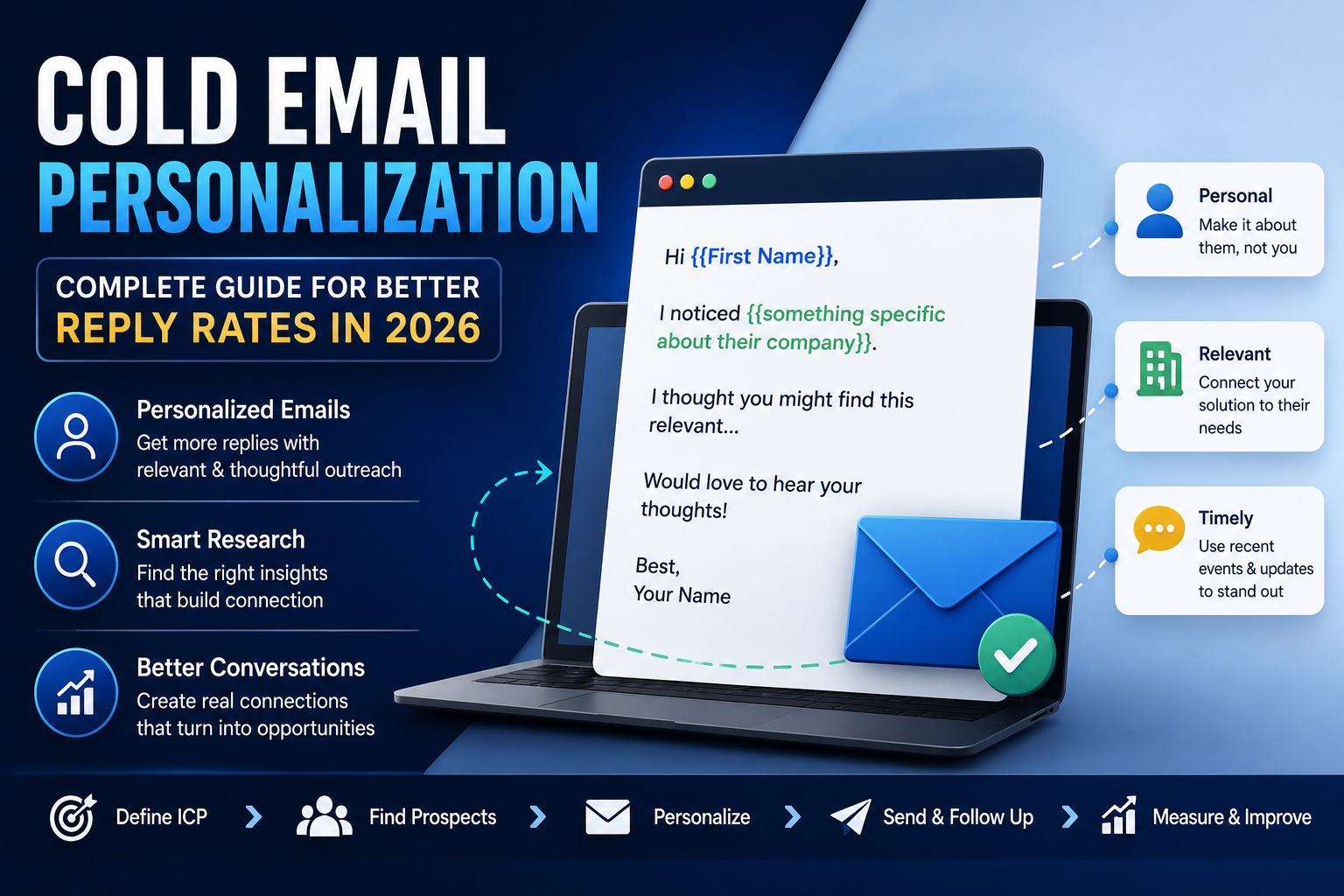
- Cold Email Personalization: Complete Guide for Better Reply Rates in 2026
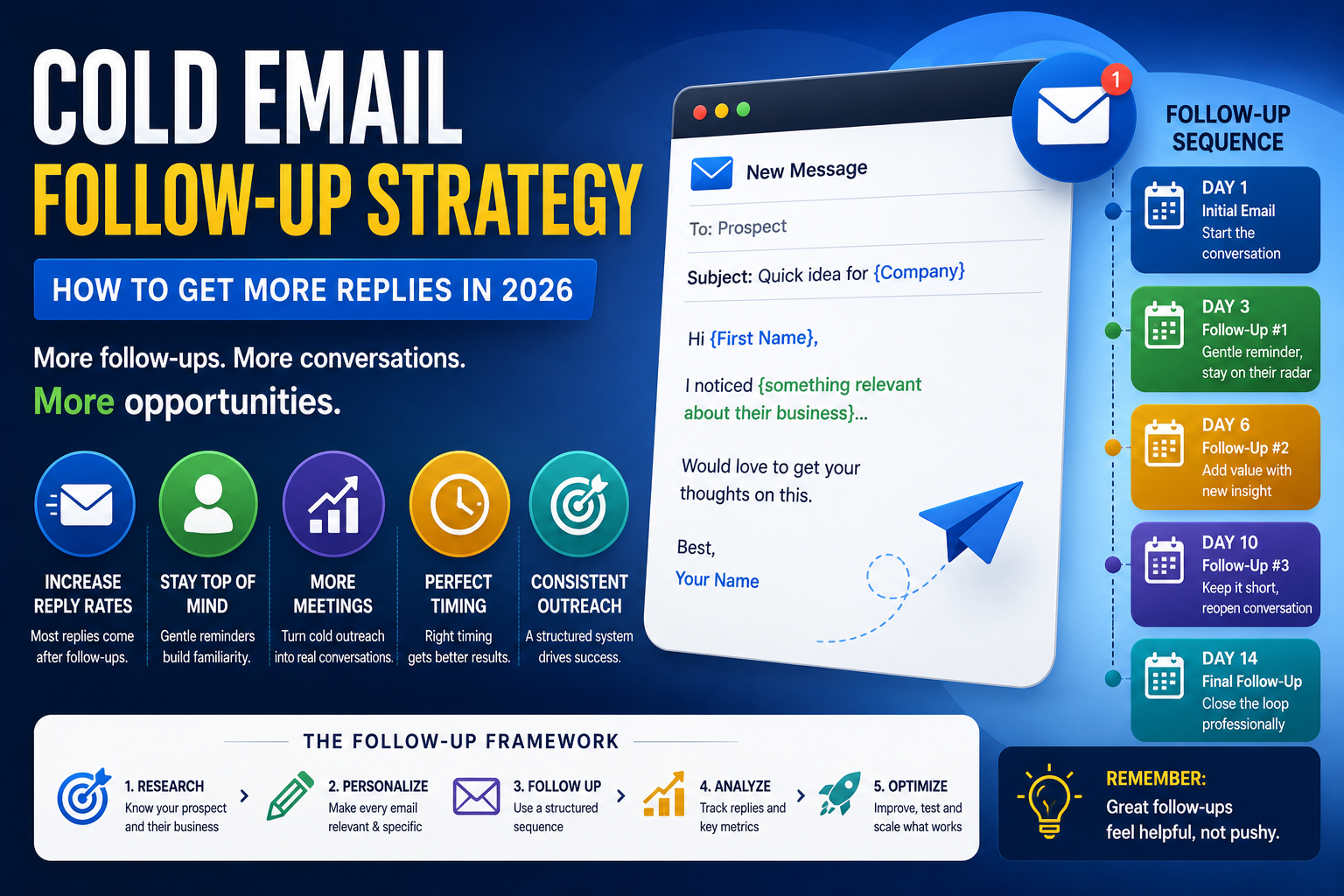
- Cold Email Follow-Up Strategy: How to Get More Replies in 2026
- How to Generate Sales Meetings with Cold Email: Complete Guide for 2026
This creates a natural content journey:
Prospect List → Decision-Maker → Verification → Cold Email → Personalization → Follow-Up → Sales Meeting
Conclusion
Email verification is one of the simplest ways to improve the foundation of a cold email campaign.
It helps you identify potentially invalid or risky addresses before you send outreach, reducing avoidable bounces and helping maintain cleaner prospect data.
But verification should never be treated as a magic solution for deliverability.
A successful cold email system combines:
- Accurate prospect data
- Email verification
- SPF, DKIM, and DMARC
- Responsible sending practices
- Relevant messaging
- Personalization
- Consistent follow-ups
- Ongoing monitoring
The objective isn't to send more emails.
It's to send better emails to the right people using reliable data.
When your prospecting and data-quality processes are strong, your outreach team can spend less time dealing with bad contacts and more time having meaningful conversations with potential customers.