Most buyers start looking for a lead generation company after a freelancer fizzled out or an in-house SDR cost more than the pipeline justified. If you'd rather skip the reading, request a quote from Maan Digital Solutions. The search results rarely help: most price pages cover LinkedIn Ads, and the buyer wants someone else sending the messages. This guide prices that second option for Indian SMEs and mid-market firms, and gives you a formula to run on any quote. LinkedIn passed 100 million members in India in February 2023, so reach isn't your constraint. A clear price is.
We start by splitting LinkedIn Ads cost from managed outreach cost, because the two are billed in different ways. Then we compare four pricing models side by side, work through an example with real arithmetic, and list the warning signs worth checking in any quote before you sign.
Key takeaways
-
LinkedIn Ads and managed LinkedIn outreach are billed differently: ads charge for clicks or leads, outreach charges for people's time.
-
Agencies sell managed LinkedIn outreach on four models: monthly retainer, pay per lead, pay per meeting and hybrid.
-
Cost per qualified conversation equals total monthly spend divided by meetings with buyers who fit your ideal customer profile.
-
A lead is whatever the contract says it is, so define "qualified" in writing before paying for a single one.
-
Managed outreach suits B2B sellers with a clear offer and a sales team that replies to positive responses within two working days.
What does a lead generation company cost in India?
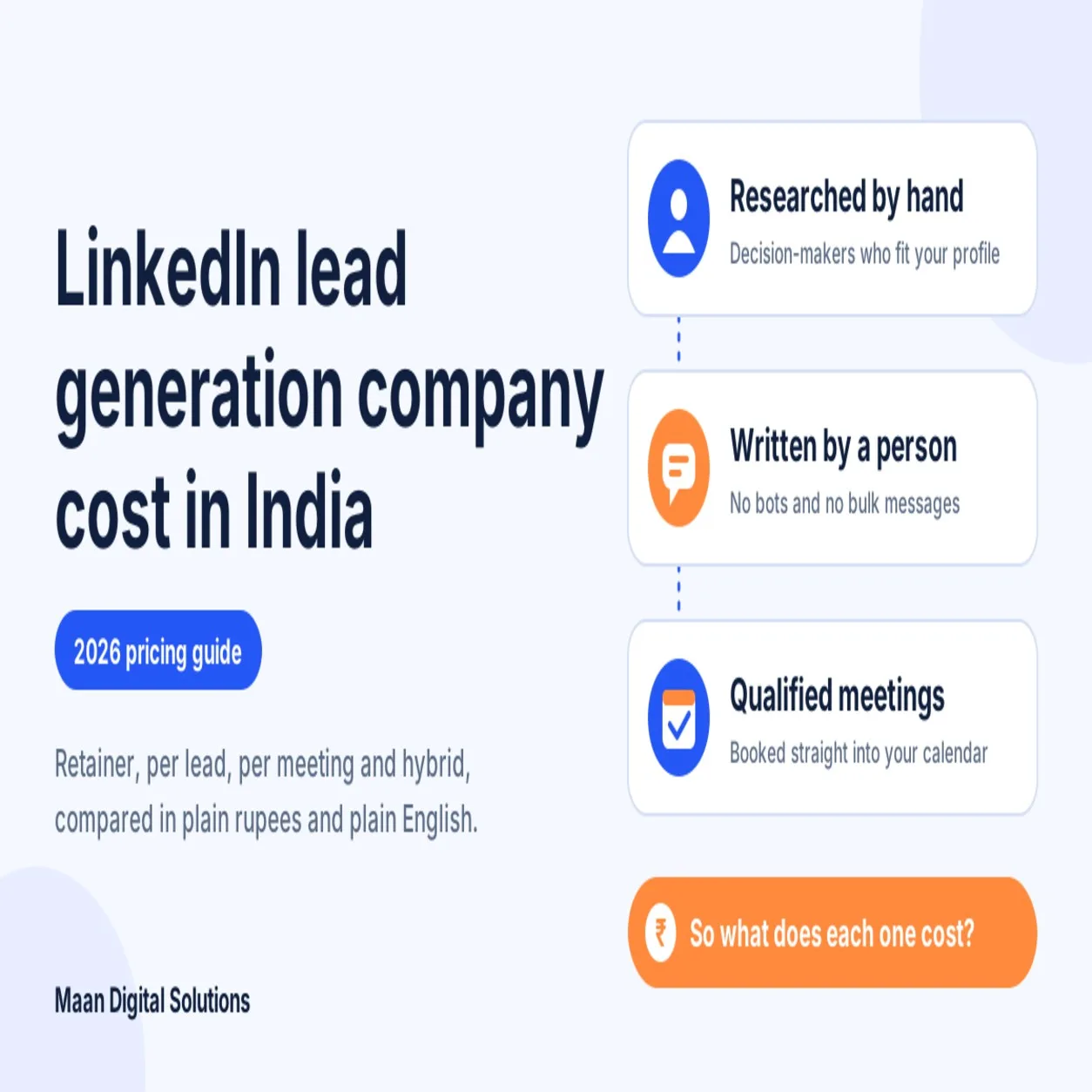
Indian agencies price managed LinkedIn outreach in one of four ways: a monthly retainer, a fee per lead, a fee per booked meeting, or a retainer with a per-meeting bonus. The model matters more than the headline number, because each one decides who carries the risk when replies come in slow.
Search that question and you'll mostly land on LinkedIn Ads pricing, which is a different product. In 2022, Business Insider India quoted TRA Research's chief executive saying an advertised LinkedIn lead could cost about ₹1,300 and fall to roughly ₹200 with disciplined spending. Those are 2022 ad-platform figures, so read them as direction rather than a quote. Rates will have moved since, and none of that money pays a person to write a message.
Picture a 60-person software firm that wants six meetings a month with CTOs at mid-sized companies. Its real question is what a booked meeting costs, and who absorbs the loss when none arrive. The rest of this post prices that.
B2B LinkedIn marketing costs: ads versus managed outreach
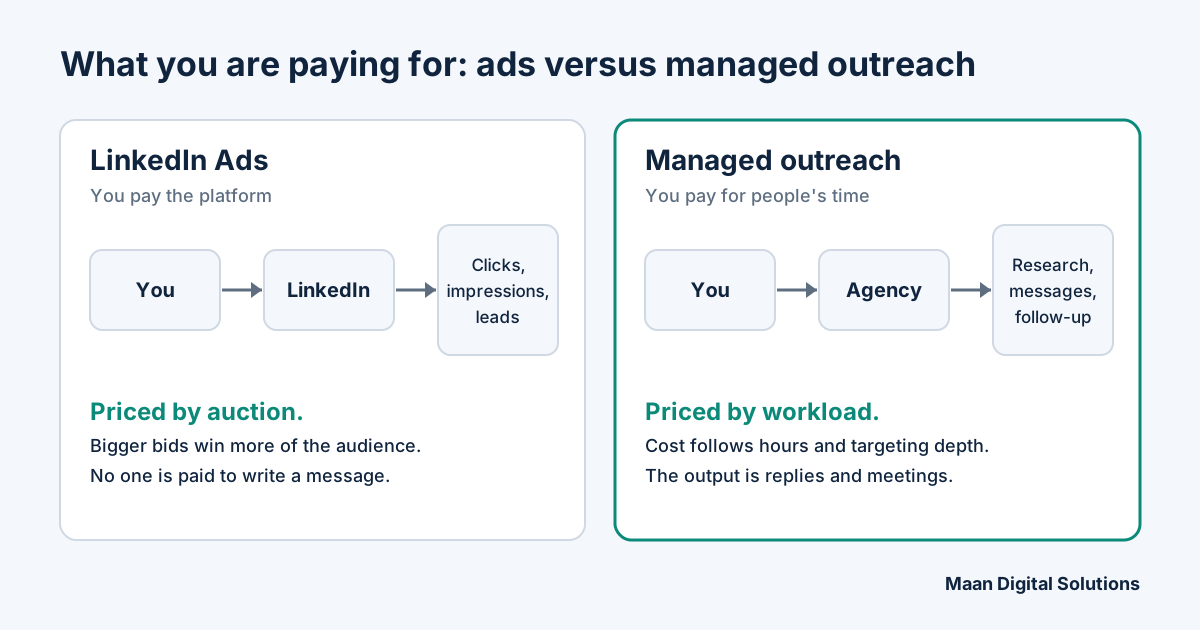
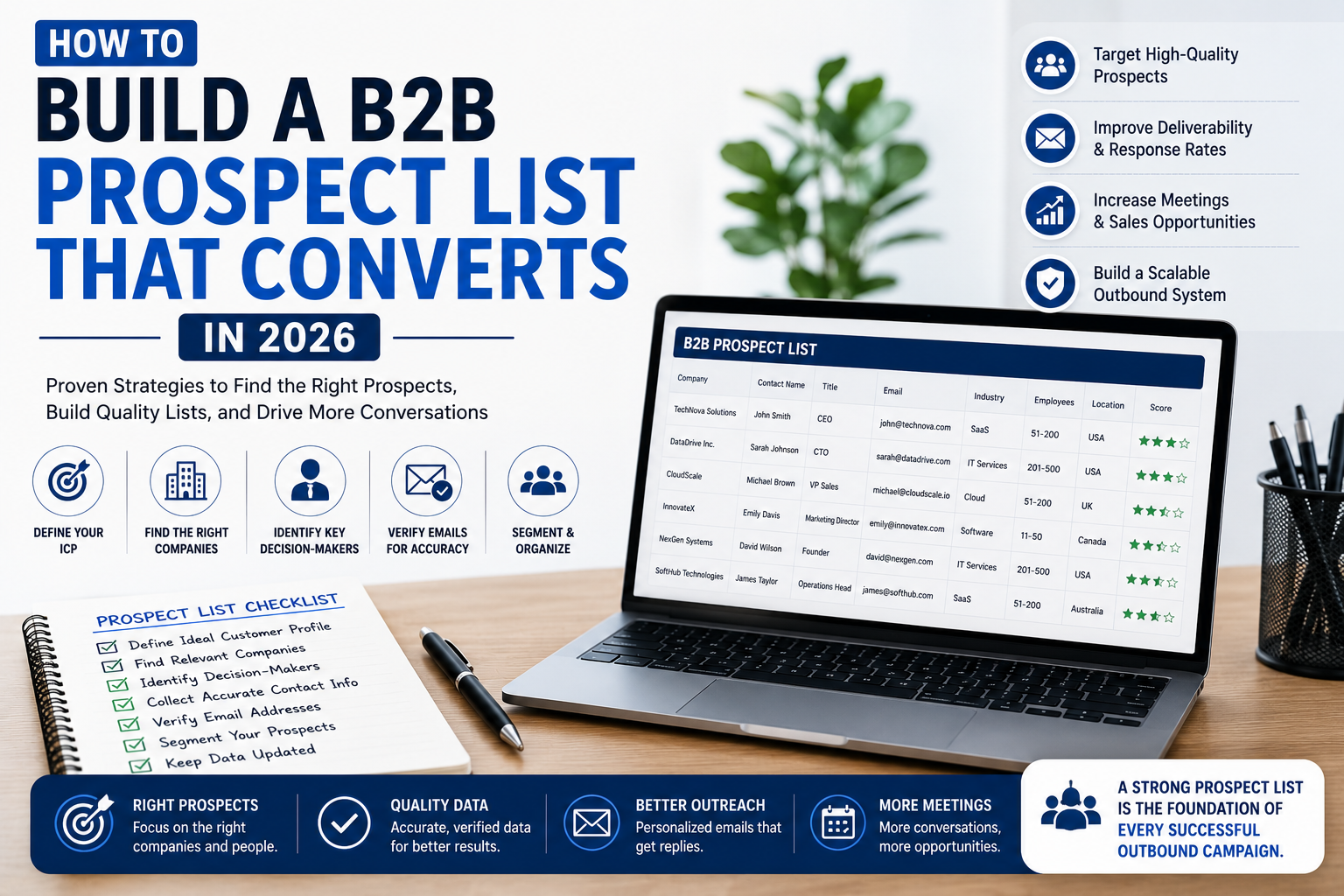
Managed LinkedIn outreach is a service where an agency researches your prospects, sends personalised connection requests and follow-ups from your profile, and passes the replies to your sales team.
Ads buy clicks from LinkedIn. Outreach buys human hours. That changes what you budget for. Ads need creative, a landing page and enough spend for the algorithm to settle; LinkedIn's own suggestion, as reported by Business Insider India in 2022, was around $5,000 a month. Outreach needs a defined ideal customer profile, verified prospect data and a weekly slot where someone on your side reviews replies.
The organic side lowers the cost of both. Neil Patel's seven LinkedIn strategies for B2B marketing cover the company-page and content work. Profile optimisation matters more than most buyers expect, because prospects usually open your profile before they answer a message.
Our view, which an ads specialist would dispute: ads win when your offer is already familiar and your audience runs into six figures, and outreach wins when you sell a considered service to a few hundred named buyers. An IT services firm chasing 200 target accounts will watch ads spend money on thousands of people it never wanted.
How LinkedIn B2B lead generation is priced: four models?
Agencies charge for LinkedIn outreach through four structures, and each one puts the risk in a different place.
|
Model |
You pay for |
Who carries the risk |
Fits best |
The catch |
|
Monthly retainer |
The agency's time and tools, whatever the result |
You |
Teams that want steady volume and ongoing tuning |
A weak month still costs the full fee |
|
Pay per lead |
Each contact the agency labels a lead |
Mostly you |
Firms with a tight, written lead definition |
"Lead" can mean a reply that says "send details" |
|
Pay per meeting |
Each booked and attended meeting |
The agency |
Firms with a narrow ideal customer profile and fast follow-up |
Higher fee per meeting; off-profile calls and no-shows need rules |
|
Hybrid |
A smaller retainer plus a per-meeting bonus |
Shared |
SMEs that want downside cover without starving the agency |
Both sides must agree what counts |
A retainer is cheapest per hour of work and costliest per wasted month. Pay per meeting is the reverse. Hybrid pricing is the usual compromise when neither side wants to carry everything.
For a sense of output, the CMP Techno Services case study reports an average of 10 leads a month for an IT services firm, built on targeted prospect research and personalised outreach.
Our position: for most SMEs, pay per lead is the weakest of the four. The agency earns when someone replies, so it optimises for replies, and a reply that says "send details" isn't a meeting. Pay per meeting fixes that, but only if "meeting" is defined tightly enough that an off-profile call doesn't count.
The cost per qualified conversation formula:
Cost per qualified conversation is your total monthly spend divided by the number of conversations held with a buyer who fits your ideal customer profile and has a live need.
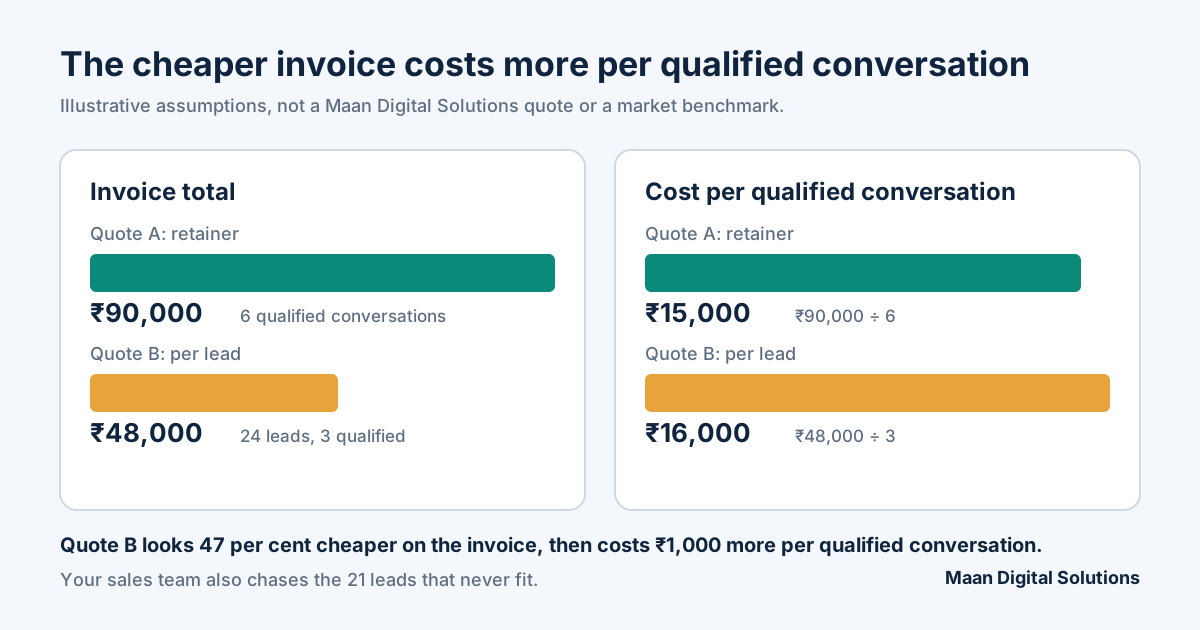
Total spend has four parts: the agency fee, data costs, tool costs and the hours your own team spends reviewing replies and joining calls. Buyers forget the last one most often. If the same agency also sells SEO or ads, as a digital marketing agency in India such as Maan Digital Solutions can, ask for the outreach fee as its own line.
Here's a worked example. The numbers are illustrative assumptions, not a Maan Digital Solutions quote or a market benchmark. Take two quotes for the same month. Quote A is a ₹90,000 all-in retainer that delivers 6 qualified conversations, so ₹15,000 each. Quote B is ₹2,000 per lead, with 24 leads delivered and ₹48,000 billed, but only 3 fit the profile, so ₹16,000 each. Your sales team also spends days chasing the 21 leads that never had a chance. Quote B looked 47 per cent cheaper on the invoice. It wasn't.
Write the definition of "qualified" into the contract. Four fields are enough: job title and seniority, company size and geography, a stated need, and a meeting that actually took place. Some agencies will resist. That's useful information.
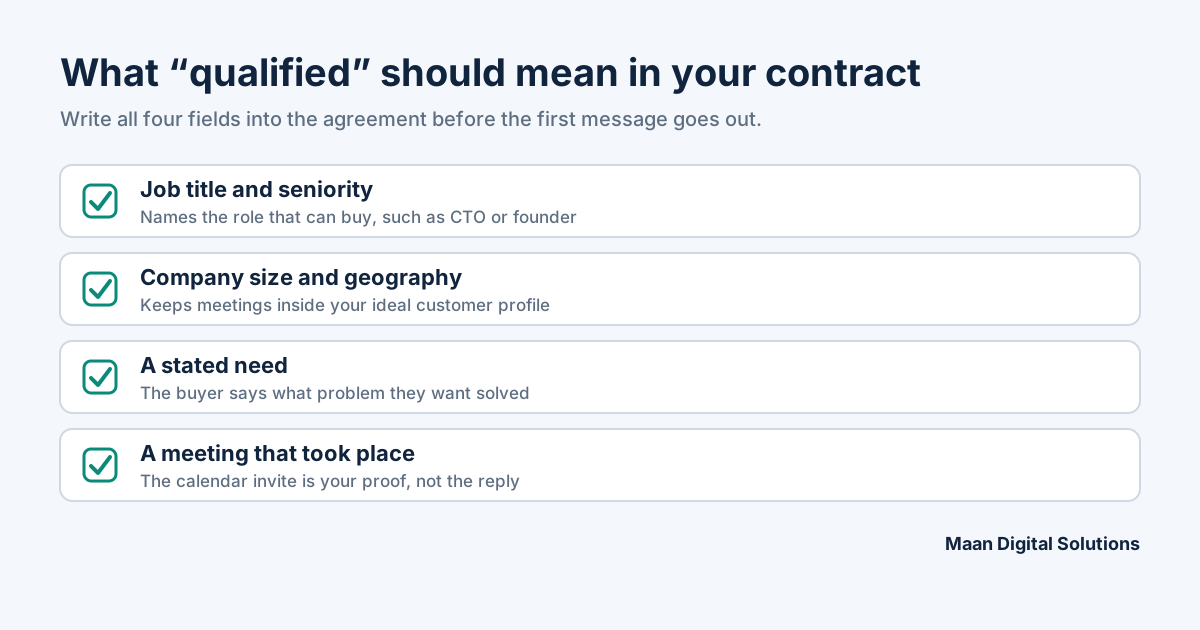
A fair objection is that an agency can game any definition. Some will, which is why the definition sits in the contract and the calendar invite is your proof.
What pushes a LinkedIn outreach quote up or down?
Four variables move an outreach quote more than any others.
-
Buyer seniority: founders and CXOs take more research and more touches per reply than managers, so quotes usually rise as the target title climbs.
-
Data quality: verified roles and contact details cost money to build, and a list full of stale profiles burns invitations.
-
Channel mix: adding cold email marketing brings sequencing, inbox set-up and verification work, and the reply rates differ from LinkedIn's.
-
Term length: a one-month trial can't prove pipeline in a business whose deals take 90 days to close.
One more factor sits outside that list: account safety. LinkedIn limits how many invitations an account can send and, as far as we know, doesn't publish one fixed weekly figure. A cheap quote built on bulk automation is buying volume with your account's reputation. Our outreach is human and personalised, which caps weekly volume, so we hold weekly strategy meetings with clients and tune targeting from the replies. With fewer sends, targeting has to carry the result.
Red flags to spot before you sign:
Some quotes look fine and still fail in month one. Watch for four things.
A guaranteed number of meetings with no definition attached. Nobody controls how many busy CTOs say yes, so a guarantee usually means the word "meeting" has been stretched. Ask for the definition first.
No sample of the target list. Before outreach starts, a serious agency can show you the kinds of companies and job titles it plans to contact. If all you see is a methodology slide, you're buying on trust.
No reporting rhythm. Weekly or fortnightly numbers on invitations sent, acceptances, replies and meetings are the minimum. Without them you can't spot a targeting problem until the next invoice lands. Maan Digital Solutions' LinkedIn lead generation service is scoped around your target industries, locations and buyer roles, and includes performance updates on outreach activity and responses.
A long lock-in with no exit. Three months is a fair minimum for outreach, because replies take time to build. Twelve months with no performance review is a bet on the agency's goodwill.
Who shouldn't buy managed LinkedIn outreach?
Managed LinkedIn outreach doesn't suit every seller, and a decent agency will say so before taking your fee.
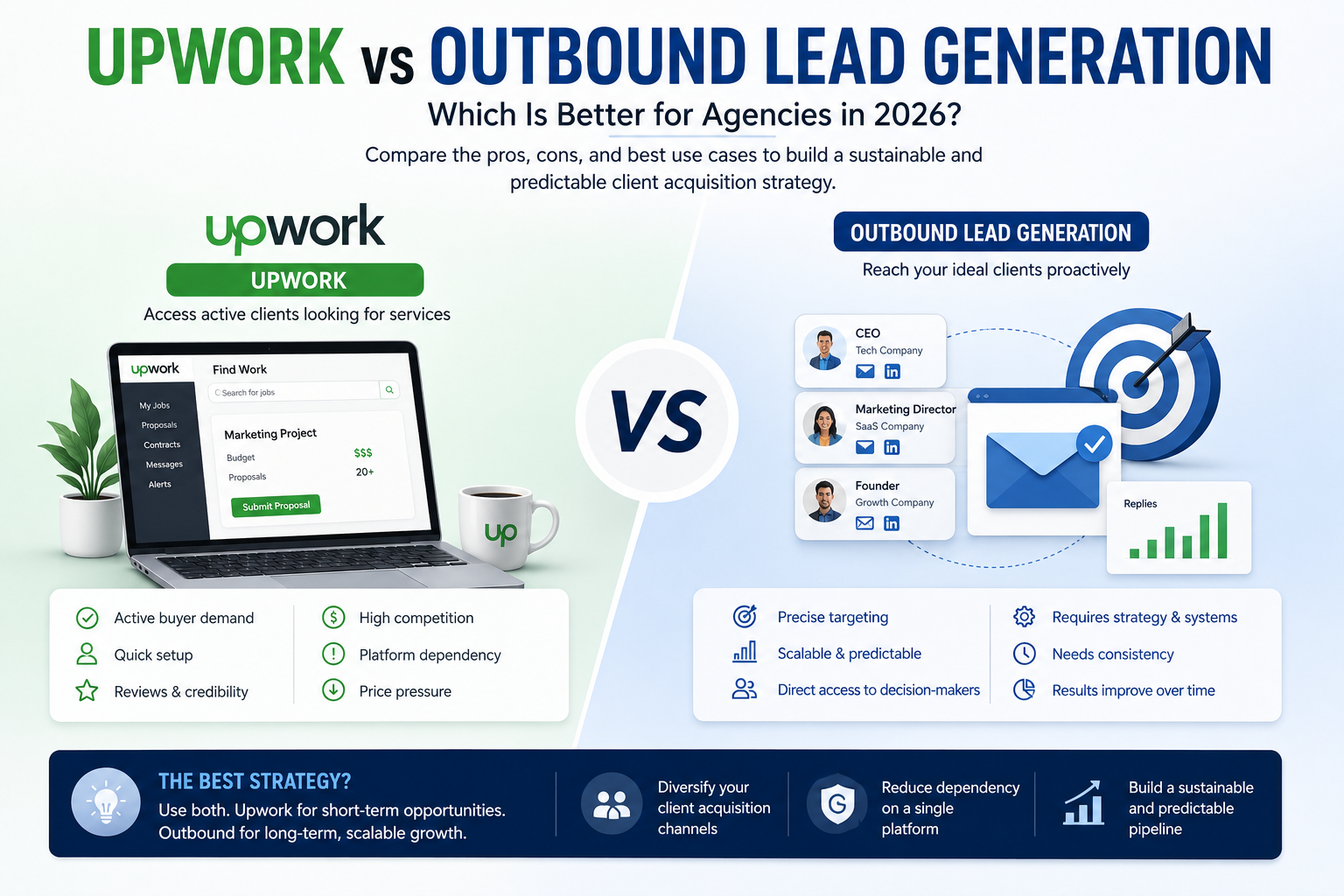
It won't fix a vague offer. If you can't say in one sentence who you help and what changes for them, no message sequence will compensate. It fits poorly when your buyers aren't on LinkedIn, say a regional manufacturer selling to tradespeople (a channel such as Upwork lead generation may suit project-based buyers better), or when deal value is too small to pay back a monthly programme within a few closed sales. It also fails quietly when nobody on your team can answer a positive reply within two working days.
B2B companies with a defined offer, a named buyer role and a sales owner for replies get the clearest read on whether outreach works.
Another objection we hear: wouldn't an in-house SDR cost less? Sometimes. An SDR gives you control, but you carry salary, tools, data and management time, where an agency turns those into one variable fee. Run both through the cost per qualified conversation formula before deciding.